Attunement as Ethics
Going beyond rules, philosophies and thought experiments

This is the essay I wish I could’ve found when I first started wrestling with morality — wondering what’s right and wrong, what’s good and bad, what it means to live ethically. It would’ve helped me resolve some fundamental existential confusions I didn’t even know how to name. And maybe saved me tens of hours defending my ideas of “good” or trying to win moral arguments I didn’t even believe in.
Here’s to that earnest, self-righteous 20-year-old who clung to being right because he hadn’t yet learned how to just be with the mess.
P.S. Please excuse the slightly preachy tone that unintentionally crept into my writing here, still unlearning.
Many of us come to ethics looking for clarity, for solid ground.
We want to know: what’s the right thing to do?
Or: what kind of person should I be?
Or: what leads to the best outcome for the most people?
These are good questions, important questions. But underneath them often sit hidden desires for clean answers and a sense of moral safety in a world that feels ethically precarious. Shame too plays a quiet, powerful role in this hunger for moral safety. We don’t just want to do right, we want to be good and lovable and above reproach.
This gives rise to subtle (or not-so-subtle) forms of:
Perfectionism: “I need to be exactly right in this conflict.”
Certainty-seeking: “I need to know I won’t cause harm.”
Authority fixation: “Tell me what to do, so I don’t mess up.”
So we reach for frameworks. We try to fix our moral compass. We try to reason our way out of the dark. We want logic and coherence to make our dilemmas go away. We think if we just stack the right arguments, if we line up the perfect moral equation, it’ll all make sense.
I’ve seen myself (and others) take certain ethical frameworks and lenses, and turn them into axioms. We reify them, turning contextual perspectives into fixed identities or rules. And that leads to some kind of collapse. The space of possible actions shrinks. We lose flexibility. We lose feel.
Reification collapses aliveness into mechanism. And that leads to less freedom, less wisdom, and often, more harm.
Emptiness of Frameworks
There’s a moment in every honest ethical inquiry where frameworks begin to shake, where the neatness of theory collides with the mess of reality. Life throws us moral ambiguity, conflicting duties, unpredictable consequences, emotional chaos, people we love doing things we hate, and situations where no option is clearly right.
The three fundamental ethical frameworks that western philosophy offers all fail in their own ways:
We try to follow certain rules (deontology), but the rules turn cruel or they clash.
We try to maximize good (consequentialism), but what counts as good slips through your fingers.
We try to embody virtue (virtue ethics), but suddenly we’re performing morality, not living it. Or we end up overriding/ignoring our anger, shame, or fear in order to stay “good”.
It’s obvious that no framework holds up in every situation. And that’s not because we haven’t found the right one, but because maybe there isn’t one.
Every action arises interdependently, from conditions — history, culture, emotions, relationships, threats, bodily state. Can there be any inherently right action? a definitive idea of a “good person”? a stable self making decisions in a vacuum? I haven’t found any ethical framework that can claim intrinsic authority without making up a fiction about certainty; about how the world is, what matters, for whom, and why it must always apply.
This is not relativism. It’s saying: no fixed position can ever hold all the complexity of living a moral life. It’s about seeing that all of it is built on shifting ground. That even our most sacred principles wobble when life throws us something wild and real. And that realization, not as a doctrine, but as a felt recognition, is what some traditions call emptiness. Not absence. Not void. Just the understanding that no view has the final word. That everything is conditioned and contextual. And therefore, everything has to be held with care.
Emptiness doesn’t negate ethics, it frees us from rigidity.
Bodhicitta
If ethics isn’t about following rules, maximizing goodness, or being virtuous, then what is it grounded in? What keeps us from collapsing into apathy, nihilism, or self-indulgence?
Mahāyāna Buddhism folks talk about bodhicitta — a tenderness that arises when the self is no longer the center of gravity. A natural care that flows not because a rule commands it or because we want to be seen as kind, but because the boundary between us and others has grown porous. Many traditions and schools of thought use different words to point toward this softening of self.
I don’t see it as some statement like “everyone is inherently good.” That too can become reified. Rather, it feels like an invitation: Investigate our own minds. See what arises when fixation softens. See what happens when we let our heart feel everything — the pain, the stuckness, the love, the failure, the joy.
And often, somewhere underneath the strategies and shame and fear and moral grasping, we all can discover a strange warmth, a natural tenderness. A quiet wish: may this world be held better. May I cause less harm. May I be more awake here.

Ethical Sensitivity and Attunement
Ethics, from this space, can go beyond following rules, rationally deducing the right action, or cultivating static virtues. We can aspire toward cultivating a sensitive responsiveness, a felt attunement to what the moment is asking of us.
It can be like jazz. We listen. We respond. We improvise. We’re in relationship with the moment, with the other musicians, with the room. We might return to motifs like honesty, care, justice, but we don’t repeat them rigidly. Each note arises from listening. And the feel matters as much as the form. If we hit a sour note, we don’t stop playing. We fold it into the next phrase. We keep the groove alive.
Most of us were taught to think of ethical choices as moments, isolated points in space-time where you either do the right thing or you don’t.
I told the truth or I didn’t.
I betrayed someone or I didn’t.
I helped or I didn’t.
And if I “got it wrong,” then that’s it. I failed. I’m bad. But real life doesn’t play out like that. Ethical conflicts are not single points. They’re unfolding processes. There’s before. There’s during. There’s after.
There’s how I got there — what fears, patterns, and constraints shaped the moment.
There’s what happened — how I moved, what I sensed, what I missed.
And there’s what I do next — the repair, the silence, the reconnection, the change.
I can hurt someone and come back differently, more sensitive than before. I can cause harm and then listen, learn, apologize from the heart. I am not trying to get it right once and be done. I want to stay in the dance, to keep attuning, adjusting, responding, and growing.
There’s an alive shifting pulse:
Tightening when something matters.
Loosening when grace is needed.
Listening when words don’t help.
Pausing when action would be reactivity.
Moving when waiting would be cowardice.
This stance lets us nurture a heart that keeps turning back toward care, again and again. We cultivate ethical attunement: a living sense of what this moment, with all its complexity, is asking of us. It’s the thing that lets me say:
“I may not get it right. But I can stay open. I can feel. I can respond. I can repair. I can care.”
There’s a pleasure in relaxing into this kind of attunement. In sensing I listened well. In seeing someone soften because I softened. In telling the truth that was scary but kind. It’s the pleasure of connection.
Of course, all of this is easier said than done. Our conditioning gets in the way, pulling us toward defensiveness, numbness or rigidity. What do we do about our (and others’) violent and manipulative instincts?
Ethical Development in Children
Children often act "unethically”. They lie, steal, hit. They scream “mine!” and bite their siblings and hide the broken vase. But we don’t (usually) call them bad people. Because we know that they’re still becoming. Their nervous systems aren’t regulated. Their empathy circuits aren’t fully online. They’re creatures of need, fear, play, power, and confusion. They have strong impulses and can’t help but get taken over by them. They are great exhibits to witness how morality actually develops.
Early moral training often starts as obedience — “Don’t do that,” “Say sorry,” “Be nice”. And that’s developmentally fine. Kids need guardrails. But true ethical maturity is about internalizing care, not rules. What helps a child become more ethical is not punishment, but attuned care.
When a child lies and is met with curiosity… (“What made it hard to tell the truth?”)
When they hit and are met with boundaries and understanding… (“You were scared. But hurting isn’t okay.”)
When they are seen and loved even when they’re messy, they begin to feel their own impact. They begin to internalize care, not just perform goodness to avoid shame.
Eventually, a child learns to say sorry not because they’re told to, but because they feel the other person’s pain. They share because they want the joy to spread, not just because it’s “good”.
Arrested Development
When our visceral instincts do not receive such well-boundaried loving containers, the impulses that should have been welcomed, named, and guided end up distorted or buried under shame.
Resisted, they still persist. They thicken beneath the floorboards, rattling the house at odd hours. We feel them as sudden spikes flashing through the body with nowhere to go. They leak out in the form of passive-aggression, control, manipulation, lash outs, quiet sabotage.
The anger, the desire, the urge to dominate, the impulse to run — these were the parts that got us in trouble. The ones that invited punishment, withdrawal, shaming. So we tag them as bad and dangerous. We see them through the eyes of the people who feared them. And so we try to suppress them and become tight, controlled, "good." Or we push back and become defiant, cynical, hard to reach.
This keeps us stuck in the same patterns, insensitive to our needs, and insensitive to the world around us. Out of attunement.
What We Need
What we need are people and environments that can bring care to the parts of us that stalled out.
Spaces where we can reflect on our impact without being destroyed by it.
Relationships where we’re allowed to mess up and repair.
Inner dialogue that doesn’t exile the messy parts, but listens, learns and integrates.
The more love and safety we experience while being imperfect, the more space there is for ethical sensitivity to take root. We start wanting to care, because we’ve been cared for.
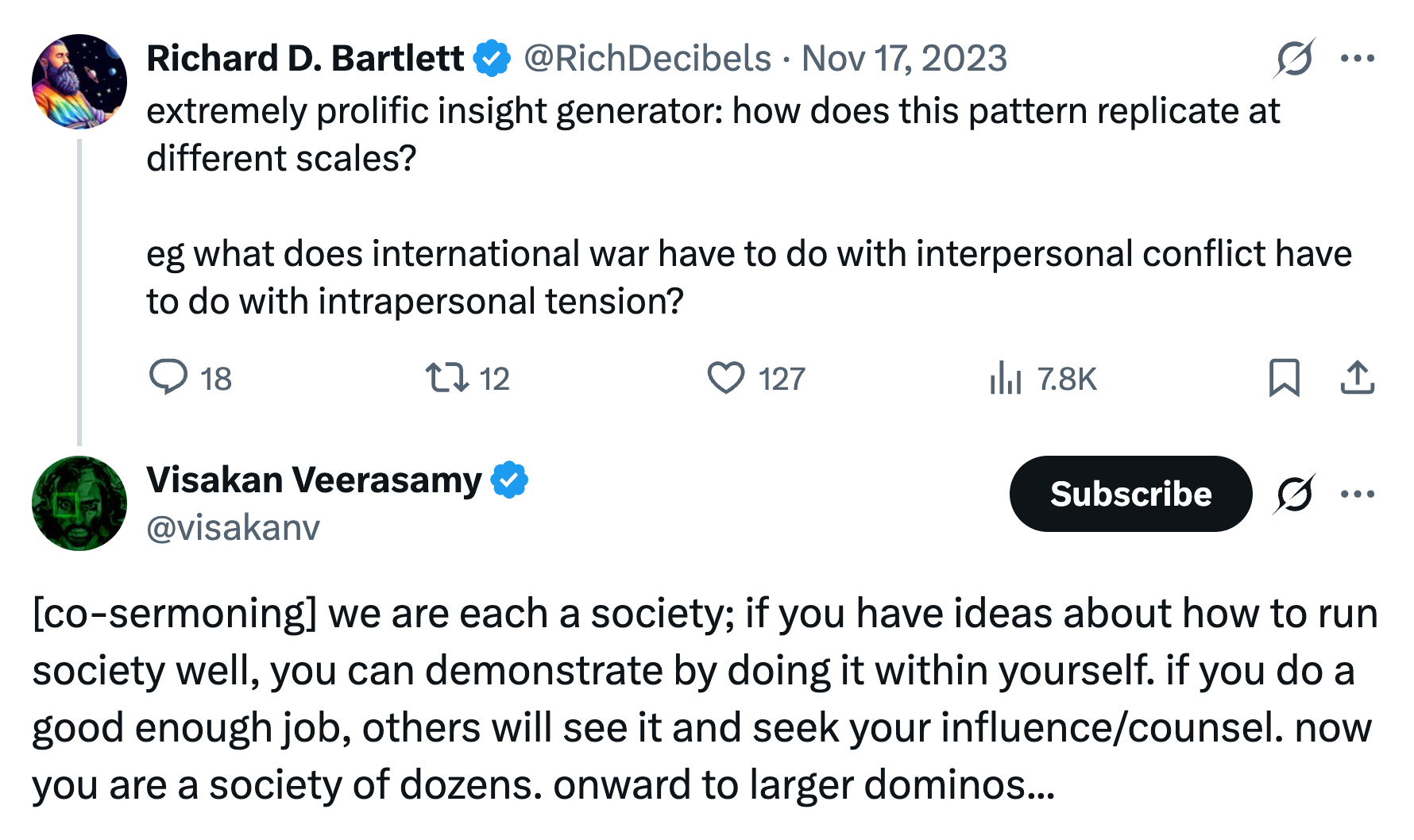
And this all starts with attuning to our inner world — thawing the impulses we froze, making contact with the visceral charge we were taught to fear, learning to hold the voltage without discharging it sideways. Not judging the part of us that gets furious, but listening to what it’s guarding. Not labeling our scared parts as weak, but sensing what kind of safety they are seeking. Not seeing certain desires as problematic, but letting them show their longings. When we stop splitting our interior into “good” selves and “bad” selves, there’s space for responsiveness.
That’s the training ethical life actually needs: to feel what’s there without flinching, to relate instead of control, to move with presence rather than panic. Inner ethics and outer ethics are mirrors. From there, caring stops being performance. It becomes the natural tilt of a system that’s finally in contact with itself.